
The Hidden Cost of Financial Avoidance: Why Women Avoid Their Money and How to Stop

Table of Contents
- The Statement You Haven't Opened
- What Financial Avoidance Actually Is
- Why Women Are Especially Vulnerable to Financial Avoidance
- What Financial Avoidance Looks Like in Real Life
- The Hidden Cost of Not Looking
- The Connection Between Mental Health and Financial Avoidance
- How to Stop Avoiding Your Money
- You Don't Have to Do This Alone
- Frequently Asked Questions
The Statement You Haven't Opened
There's a bill sitting in your inbox. It's been there for three weeks.
You know it's there. You think about it more than you'd like, actually. You think about it when you're trying to fall asleep. You think about it when you're in the shower. And still, every day, you find a reason not to open it.
Or maybe it's not a bill. Maybe it's your investment account that you set up three years ago and haven't logged into since. The retirement statement that arrives every quarter and goes straight into a drawer. The email from your divorce attorney that requires you to review a financial document and respond, and every time you see it, you feel a wave of something you can't quite name.
If any of this sounds familiar, I need you to hear this first: you are not bad with money. You are not lazy or irresponsible or broken. You are not the only one.
What you are is avoidant. And those are very different things.
I covered this topic on Intentional Money Moves Live in May, tied to Mental Health Awareness Month, and the response was overwhelming. Women wrote in from every corner of my audience saying some version of the same thing: I thought I was the only one who did this.
You're not. And there's a way through.
What Financial Avoidance Actually Is
Financial avoidance is the pattern of steering clear of money-related tasks, decisions, or information because engaging with them produces anxiety, shame, or overwhelm.
It is not a character flaw. It is a coping mechanism. And like most coping mechanisms, it developed because at some point, it protected you from something that felt like too much.
Maybe money was a source of conflict or scarcity in your home growing up, and you learned early that looking at finances meant bracing for bad news. Maybe you've been through a financial crisis, a divorce, a period when you genuinely didn't have enough, and your nervous system learned to associate financial information with threat. Maybe you were never taught how any of this works, and every time you try to engage, the gap between where you are and where you think you should be feels so enormous that shutting the tab is easier than facing it.
The avoidance made sense when it started. The problem is what it costs you when it becomes a pattern.
Financial avoidance is different from simply being disorganized or busy. It's characterized by a specific emotional response: the dread, the physical tension, the mental sidestep. You don't forget to check your account. You actively don't do it. That distinction matters, because it tells you something important about what actually needs to change.
Why Women Are Especially Vulnerable to Financial Avoidance
Financial avoidance affects people of all genders, but women face a specific set of conditions that make it more likely to develop and harder to shake.
We were often excluded from the conversation. For generations, money management was treated as a male domain. Even women who grew up in financially stable households frequently absorbed the message, directly or indirectly, that the finances were being handled by someone else. When you've been told your whole life that this isn't really your area, engaging with it as an adult can feel like walking into a room where everyone else speaks the language fluently and you're still learning the alphabet.
We're more likely to have experienced financial disruption. Career interruptions for caregiving, wage gaps that compound over time, and the financial devastation of divorce all create conditions where looking at the numbers can feel genuinely painful. When your financial reality reflects years of inequity rather than years of opportunity, avoidance can feel like the only self-protective move available.
Shame gets activated differently. Women are socialized to connect their self-worth to how well they manage things, their households, their relationships, their responsibilities. When finances feel out of control, many women experience that as a reflection of who they are, not just what happened. That shame is a powerful driver of avoidance. If looking at the numbers means confronting evidence that you've "failed," not looking feels safer.
Life transitions create a specific kind of overwhelm. Divorce, widowhood, a major job change, the death of a parent, an unexpected health crisis: these transitions often bring sudden financial responsibility for things a woman may have never had to manage before, at exactly the moment when her emotional and cognitive bandwidth is most depleted. Avoidance in those moments isn't weakness. It's a nervous system that is simply at capacity.
Understanding why avoidance develops doesn't mean accepting it as permanent. It means approaching yourself with the compassion that's actually required to move through it.
What Financial Avoidance Looks Like in Real Life
Financial avoidance doesn't always look dramatic. Often it's subtle, so normalized that you might not have recognized it by name until right now.
Here's what it looks like in practice.
Unopened statements and notifications. Paper statements that go straight to a drawer. Emails from financial institutions that you mark as read without opening. App notifications you dismiss without looking at the number.
Avoidance of financial conversations. Changing the subject when your partner brings up money. Deflecting when your attorney asks a question about your assets. Keeping your financial situation vague with people who might actually be able to help.
The "I'll deal with it later" loop. You know you need to look at your budget, update your beneficiaries, roll over the old 401(k), review the settlement documents, or make a decision about your estate plan. And every time it comes up on your mental to-do list, it slides to tomorrow. Then next week. Then some indefinite future moment when you'll feel more ready.
Physical avoidance. A literal physical response when money comes up, a tightening in the chest, a stomach drop, a wave of dread that makes you close the tab, put down the statement, or leave the conversation.
Delegating without engaging. Handing financial decisions entirely to a spouse, parent, advisor, or accountant and never asking questions. Signing documents without reading them. Not knowing the password to your own investment account.
Spending as avoidance. This one surprises people. Sometimes avoidance doesn't look like stillness. It looks like spending, specifically emotional or impulsive spending, as a way to feel something other than the anxiety that comes with actually looking at your finances. If you've ever gone on a shopping spree right after a stressful financial conversation, you've experienced this version.
None of these behaviors make you a bad person or a lost cause. They make you someone whose nervous system developed a workaround for something that felt threatening. That workaround is now in the way of where you want to go.

The Hidden Cost of Not Looking
Here's what I need you to understand: financial avoidance is not a neutral act. Every time you don't look, something happens. Usually several things.
Fees and interest accumulate silently. Late fees, overdraft charges, credit card interest, missed automatic payments. These are small individually and significant over time. A $30 late fee every month is $360 a year. A credit card balance carrying at 20% interest that you're not actively working down is compounding against you daily.
Decisions get made by default. This is one of the most expensive consequences of avoidance, and one of the least visible. When you don't make a decision about your finances, the decision still gets made, just without your input. The 401(k) you never enrolled in means years of employer match you'll never get back. The beneficiary designation you never updated means your assets go somewhere you may not have intended. The QDRO paperwork you keep postponing could cost you pension benefits you're legally entitled to. Avoidance doesn't pause your financial life. It just removes you from the driver's seat.
Compound growth works against you instead of for you. Time is the most powerful ingredient in building wealth. Every year you delay investing, every year your money sits in a low-yield account because looking at the options feels like too much, is a year of compound growth you can't recover. This isn't about blame. It's about the very real math of what avoidance costs over a decade.
You lose negotiating leverage. This is especially critical during divorce. Women who don't engage with financial documents, don't review asset disclosures, and don't ask questions during settlement negotiations often come out of the process with less than they were legally entitled to, not because they were cheated, but because they didn't have the information to advocate for themselves. Avoidance in a financial negotiation is a concession you didn't mean to make.
The mental load compounds. Ironically, avoiding your finances doesn't make you think about them less. Most people who are financially avoidant actually think about money constantly, in a low-grade, anxious, unresolved way. The avoidance doesn't bring relief. It just postpones the kind of direct engagement that would actually produce it. The mental toll of carrying unresolved financial anxiety is real, and it takes up space that belongs to your life.
The Connection Between Mental Health and Financial Avoidance
May is Mental Health Awareness Month, and I want to name something directly: the relationship between financial stress and mental health is bidirectional.
Financial anxiety can produce avoidance. And avoidance produces more financial stress. It is a cycle, and it feeds itself.
Research consistently shows that financial stress is one of the top contributors to anxiety, depression, and relationship strain. And yet the mental health conversation and the financial conversation almost never happen in the same room. We treat them as separate problems requiring separate solutions.
They're not. They're the same problem from two angles.
The shame cycle is particularly important to name. Avoidance produces shame. Shame makes engagement feel impossible. The longer you avoid, the more shame accumulates, and the higher the emotional stakes of finally looking become. By the time some women come to me, they haven't looked at a financial account in years, not because they don't care, but because the shame of what they might see has grown into something that feels genuinely unsurvivable.
It's not. I promise you, it's not.
Whatever the number is, it is survivable. Whatever the situation is, there is a path forward. I have sat with women whose financial pictures were genuinely difficult, and I have never once thought that any of them were beyond help. Not one.
Giving yourself permission to look at the connection between your emotional wellbeing and your financial decisions isn't weakness. It's the beginning of actually changing both.

How to Stop Avoiding Your Money
Moving through financial avoidance doesn't require a complete overhaul. It doesn't require becoming a different person. It requires a few honest, small moves that build evidence that you can do this.
Here's where I tell my clients to start.
Name it without judgment. Before you can change a pattern, you have to see it clearly. Spend five minutes writing down the financial tasks you've been avoiding. Not to shame yourself. Just to make the invisible visible. What are the three things you most reliably sidestep? Naming them takes some of their power away.
Start with the five-minute rule. Pick one small financial task, the smallest one on your list, and do only five minutes of it. Open the account. Look at one number. Read the first paragraph of the document. You don't have to finish it. You don't have to solve it. You just have to look. Five minutes. Then stop if you need to. The goal is to break the pattern of not looking, not to tackle everything at once.
Separate the feeling from the fact. The dread you feel before opening a financial account is real. But it is a feeling about the number, not the number itself. The number is information. It can be worked with. The dread is telling you a story about what the number means, and that story is almost always worse than the reality. When you notice the dread, try saying out loud: "This is a feeling. The number is just information." It sounds simple. It works.
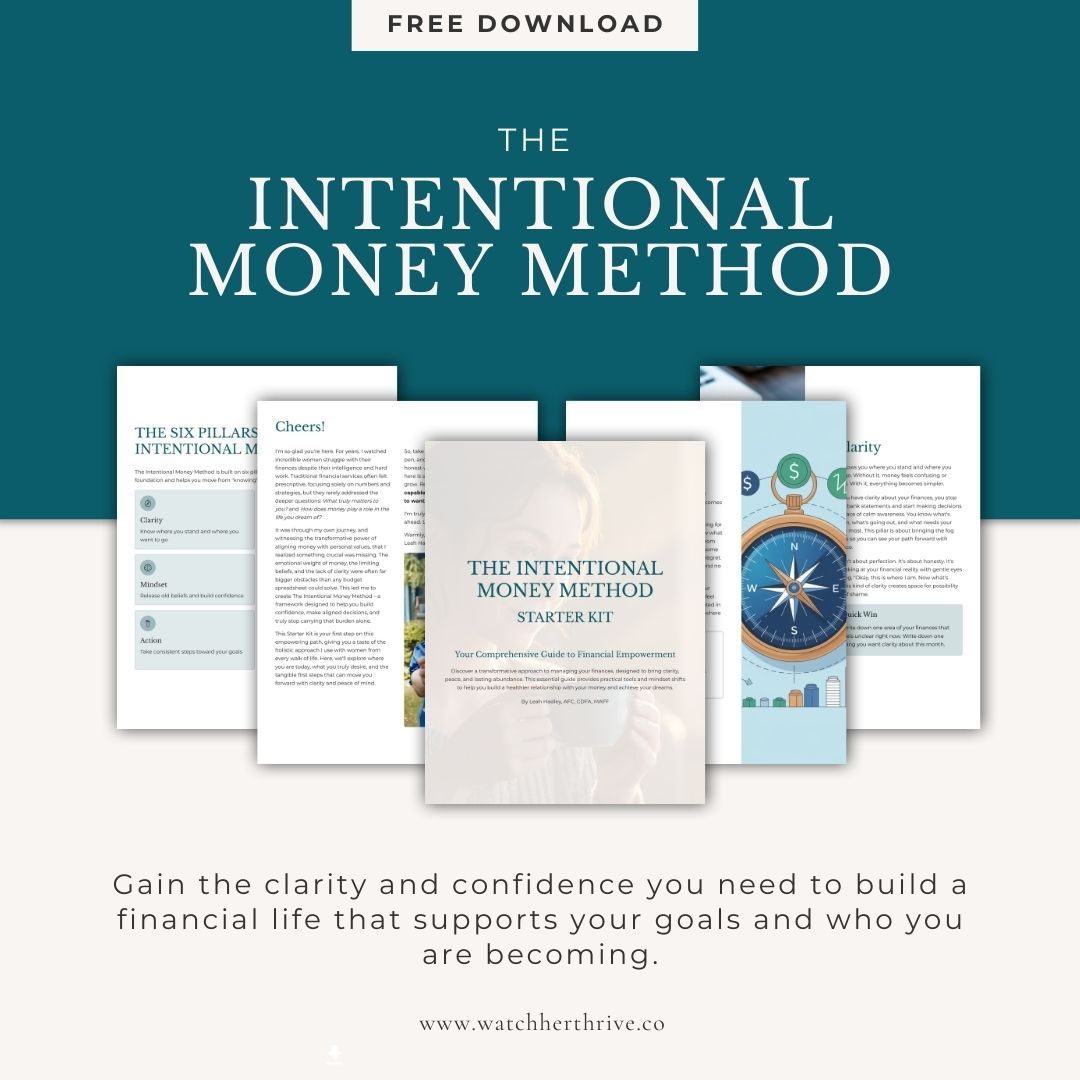
Use the Clarity pillar. In the Intentional Money Method, Clarity is the first pillar for a reason. You cannot make intentional decisions from a position of willful not-knowing. Clarity doesn't mean you have to know everything. It means you have to be willing to see what's actually there. Start with one piece of your financial picture and get clear on just that piece. Your current checking account balance. Your credit card balance. One number. That's Clarity in its smallest, most accessible form.
Find a witness. One of the most powerful things you can do when you're breaking a pattern of avoidance is to do the first scary thing with someone else present. A financial planner. A trusted friend. A community of women who are doing the same work. Having a witness for the moment you first look changes the emotional experience of it. You're not alone with the number. That matters more than it might sound.
Watch your language. "I'm bad with money" is a story. "I've been avoiding my finances" is a behavior. Behaviors can change. Stories calcify. Pay attention to which one you're telling about yourself, because the story determines what you believe is possible.

You Don't Have to Do This Alone
One of the most consistent things I've observed in nearly two decades of working with women and their finances: the ones who move through avoidance most effectively are almost never the ones who tried to do it solo.
There's something that happens in community that doesn't happen in isolation. When you're surrounded by other women who are willing to be honest about their avoidance, about the statement they haven't opened and the account they've been afraid to check, the shame starts to lose its grip. You realize you're not uniquely broken. You're not behind in some way that no one else is. You're a person who learned a coping mechanism that no longer serves you, surrounded by other people who learned the same one, and you're all working on it together.
That's what the Empowered Sisterhood is built for. It's a community of women who show up for honest conversations about money, without the toxic positivity and without the shame. Women who are at different stages, some just starting to look, some well into rebuilding, some who've made it to the other side and come back to hold a light for others.
If you're ready to stop doing this alone, we'd love to have you. Learn more here.
And if you want to go deeper with the framework behind everything I've shared in this post, my book Intentional Money: The Modern Woman's Guide to Building Wealth, Purpose & Peace walks you through the full six-pillar Intentional Money Method, including the Mindset pillar where we do the most direct work on patterns like avoidance.
Frequently Asked Questions About Financial Avoidance
What is financial avoidance? Financial avoidance is the pattern of avoiding money-related tasks, decisions, or information because engaging with them triggers anxiety, shame, or overwhelm. It's not laziness or irresponsibility. It's a coping mechanism that develops in response to financial stress, past experiences with money, or situations where financial information feels threatening. It's common, it's recognizable, and it's something that can be worked through with the right support.
Why do I feel anxious when I look at my bank account? The anxiety you feel is your nervous system responding to something it has learned to associate with threat or pain. That association often develops through past financial stress, conflict around money in your family of origin, periods of genuine scarcity, or life transitions like divorce or job loss that made financial information feel dangerous rather than useful. The anxiety is real, but it's a response to a story your nervous system learned. That story can be rewritten over time with consistent, supported, small steps back toward engagement.
Is financial avoidance a mental health issue? Financial avoidance exists at the intersection of mental health and financial behavior. It's not a clinical diagnosis on its own, but it is strongly connected to anxiety, shame, and stress responses. The relationship between financial stress and mental health is bidirectional: financial anxiety can produce avoidance, and avoidance produces more financial stress. If your avoidance is severe or persistent, speaking with a therapist who works with financial anxiety alongside working with a financial planner can be a powerful combination.
How do I stop avoiding my finances? Start smaller than you think you need to. Pick one task, the smallest one, and give it five minutes. Open the account. Look at one number. Read one document. You don't have to solve anything in that five minutes. You just have to look. Breaking the pattern of not looking is the first and most important step. From there, build on small wins. Find a community or a planner who can serve as a witness for the harder pieces. And pay attention to the story you're telling yourself about what the numbers mean. You are not your balance. You are not your debt. The numbers are information, not a verdict.
What does financial avoidance actually cost you? Financial avoidance has real, compounding costs. These include accumulated late fees and interest charges, missed enrollment windows and employer matches, compound growth lost to years of delayed investing, decisions made by default when you don't engage, loss of negotiating leverage during divorce or other financial negotiations, and the ongoing mental load of carrying unresolved financial anxiety. Avoidance doesn't pause your financial life. It removes you from the driver's seat while the car keeps moving.
Is financial avoidance common after divorce? Very. Divorce creates a specific and intense version of financial avoidance because it combines complexity, grief, overwhelm, and often sudden financial responsibility for things a woman may never have managed before. Women who weren't the primary financial manager in their marriage may face accounts they've never seen, documents they don't understand, and decisions they've never had to make, all at a time of profound emotional stress. This is one of the core reasons I built Intentional Divorce Solutions: because the intersection of divorce and financial avoidance is where I see women lose the most, and where the right support makes the most difference.
Can you build wealth if you've been financially avoidant? Yes. Absolutely yes. Avoidance is a pattern, not a permanent state. I've watched women move from years of not looking at a single account to building thoughtful, well-structured financial plans that carry them into retirement with confidence. The starting point doesn't determine the destination. What determines the destination is your willingness to begin, your access to good support, and your commitment to taking the next right step, even when it's uncomfortable. That's available to you right now.

- What It Means to Watch Her Thrive
- When Abundance Mindset Becomes Financial Self-Sabotage
- How to Overcome Financial Setbacks Without Losing Your Wealth Mindset
- Building Financial Confidence: How Action Shapes Your Financial Future
- 5 Essential Steps to Financial Independence for Women
- 14 Resources for Thriving After Divorce
Free: Intentional Investing for Women
My 24 page guide to aligning your portfolio with your goals. If investing has always felt like a language other people speak, start here.

Leah Hadley, AFC, CDFA, MAFF
Leah Hadley, AFC® CDFA® MAFF™, is a bestselling author and financial planner with over 20 years of experience helping women build wealth with intention. She is the founder of Watch Her Thrive and Intentional Wealth Partners, and the author of Intentional Money: The Modern Woman's Guide to Building Wealth, Purpose & Peace.

Amazon Affiliate Disclosure
Watch Her Thrive is a participant in the Amazon Services LLC Associates Program, an affiliate advertising program designed to provide a means for sites to earn advertising fees by advertising and linking to amazon.com.
Investment Advisory Disclosure:
Leah Hadley is a Licensed Investment Adviser Representative and the Founder of Intentional Wealth Partners, a Registered Investment Adviser. Advisory services are offered exclusively through Intentional Wealth Partners.
Watch Her Thrive is not a Registered Investment Adviser and does not provide individualized investment advice, financial planning, or securities recommendations. All content provided through Watch Her Thrive is for educational and informational purposes only.