
When Abundance Mindset Becomes Financial Self-Sabotage

I need to tell you about a conversation I had that has been sitting heavy on my heart.
A woman came to me $47,000 in credit card debt. She makes good money. She is smart, capable, and successful in her career. And she could not figure out how she got there.
As we dug into her spending patterns, a theme emerged. Every purchase was justified with some version of: "I'm claiming abundance." "The money will show up." "You have to spend money to make money." "I'm investing in myself." "Scarcity mindset is what's really expensive."
She had taken courses she never completed. Bought business coaching programs while her business barely broke even. Purchased a luxury car because "successful people drive nice cars." Invested in a mastermind she could not afford because she was "afraid of staying small."
Every decision made sense in the moment. Every purchase felt like an act of faith in her future self. Every swipe of the card felt like choosing abundance over scarcity.
And now she is drowning in debt, working overtime to make minimum payments, and feeling like a complete failure for not being "abundant" enough to make it all work.
Here is what nobody is talking about: abundance mindset without impulse control is not empowerment. It is financial self-sabotage with a spiritual veneer.
Table of Contents
- The Dark Side of "Just Say Yes"
- How Abundance Mindset Bypasses Your Better Judgment
- The Real Cost of Unchecked Impulse Spending
- What Healthy Abundance Actually Looks Like
- How to Rebuild Impulse Control
- The Bottom Line
- Frequently Asked Questions
The Dark Side of "Just Say Yes"
Somewhere along the way, the personal development world conflated abundance mindset with saying yes to everything.
Yes to the opportunity. Yes to the investment. Yes to the course, the coach, the mastermind, the certification. Yes to the upgrade, the VIP package, the payment plan.
And if you hesitate? If you want to think about it? If you need to look at your budget first?
Well, that is just your scarcity mindset talking. That is your limiting beliefs keeping you small. That is fear blocking your blessings.
This is dangerous. This is manipulative. And this is causing real financial harm.
Because here is the truth: sometimes the answer should be no. Sometimes waiting is wise. Sometimes "I can't afford that right now" is the most abundant thing you can say.
I have written about this in my post on scarcity vs. abundance mindset, where I challenged the entire binary framework. The real question is not whether you have a scarcity mindset or an abundance mindset. The real question is whether you are making decisions from fear or from clarity. And this post is the case study of what happens when that distinction gets erased.

How Abundance Mindset Bypasses Your Better Judgment
The abundance mindset messaging has created a perfect storm for impulse spending and emotional spending. Here is how it works.
It reframes hesitation as fear. In abundance culture, any pause before purchasing is labeled as "scarcity mindset" or "limiting beliefs." The message is clear: if you were truly abundant, you would not hesitate. You would just say yes. This completely eliminates the healthy pause that good decision-making requires. It makes thoughtful financial planning seem like evidence of your unhealed money wounds.
It promises future returns on present spending. "You have to invest to grow." "The ROI will be 10x." "This will pay for itself." These statements might be true. They also might not be. But in the moment of impulse, they silence the part of your brain trying to do the math. The abundance framework encourages you to focus on the potential return rather than the actual cost. To think about who you will be after the transformation rather than whether you can afford the payment plan.
It spiritualizes financial recklessness. This is the most insidious part. When you ignore your budget and make an impulse purchase, abundance culture tells you that you are "leaning into faith." You are "trusting the universe." You are "energetically aligning with wealth." It takes what is objectively a financial mistake and reframes it as spiritual growth. And then when it does not work out? When you are stressed about the credit card bill? That is your fault too. You did not believe hard enough. You were not abundant enough. This is gaslighting. Full stop.
It creates urgency around everything. "This price is only available today." "There are only 3 spots left." "The doors are closing forever." "If you are feeling called, that is the universe speaking." Scarcity marketing combined with abundance mindset messaging is designed to trigger impulse purchases. It makes you feel like saying no means missing out on your one chance at transformation.

The Real Cost of Unchecked Impulse Spending
Let me be very clear about what happens when abundance mindset overrides impulse control.
You accumulate debt you cannot manage. Those payment plans add up. Five programs at $500/month is $2,500 in monthly commitments. That is $30,000 a year before you have made a single dollar from any of them. Consumer debt creates real stress. It limits your options. It keeps you stuck in jobs you hate because you need the income to cover the minimums. There is nothing abundant about being trapped by debt you created trying to prove you were not scarce.
You never finish what you start. When you are constantly saying yes to the next thing, you do not have the time, energy, or focus to implement what you have already bought. I cannot tell you how many clients have shown me lists of courses they purchased and never finished. Programs they enrolled in and never showed up for. Coaching they paid for and did not use. This is not abundance. This is collecting "solutions" to avoid actually solving the problem.
You lose trust in yourself. Every impulse purchase followed by regret erodes your confidence in your own judgment. You start to feel out of control with money. The shame that follows often leads to more emotional spending as a way to feel better temporarily. It is a vicious cycle, and it has nothing to do with your mindset. It has to do with the patterns you have been taught.
You mistake activity for progress. Buying things feels productive. Enrolling in programs feels like taking action. But if you are doing it impulsively, without strategy, without actually implementing what you buy, you are not making progress. You are just spending money to feel like you are.

What Healthy Abundance Actually Looks Like
Here is what I want you to understand: you can believe in abundance AND have boundaries around your spending.
Real abundance is not about saying yes to everything. It is about being so secure in your worth and your future that you can say no to things that do not serve you.
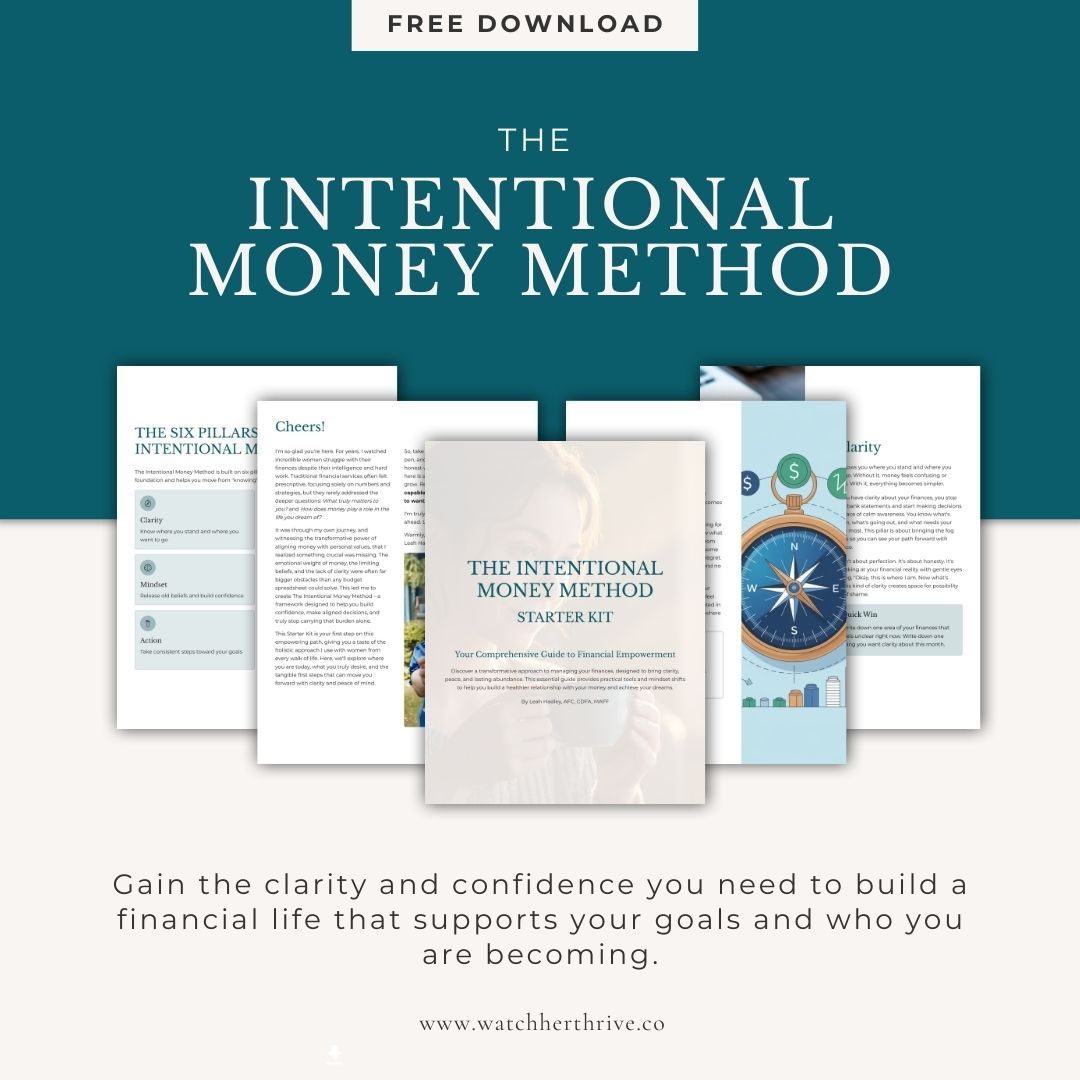
This is at the core of what I teach in the Intentional Money Method. Two of the six pillars are directly relevant here. Clarity means making financial decisions from a place of clear-eyed understanding rather than emotional reaction. Values means every financial decision gets filtered through what actually matters to you, not what a sales page tells you should matter.
When those two pillars are in place, you do not need someone else to tell you whether a purchase is "abundant" or "scarce." You already know. Because it either aligns with your values and your financial reality, or it does not.
Healthy abundance looks like this.
Pausing before purchasing. When you see an opportunity, you do not immediately pull out your credit card. You take time to think. You look at your budget. You sleep on it. This is not scarcity. This is respect for yourself and your money.
Evaluating alignment, not just desire. Just because you want something does not mean it is right for you right now. Healthy abundance asks: does this align with my current goals? Do I have the time and capacity to actually use this? Is this the best use of my resources at this moment?
Finishing before starting. Before you enroll in the next program, finish the one you are in. Before you hire the next coach, implement what your current coach taught you. This is how investments actually pay off.
Building security that enables risk. The most abundant people I know are not the ones spending recklessly on every opportunity. They are the ones who built enough financial security that they can take strategic risks. They have emergency funds so they can invest without anxiety. They have margin in their budgets so they can say yes to aligned opportunities without going into debt.
Saying no without shame. "No, that is not for me right now." "No, I cannot afford that without creating stress." These are abundant statements. They demonstrate that you know your worth is not determined by how much you spend or how many programs you enroll in.

How to Rebuild Impulse Control
If you are reading this and recognizing yourself in these patterns, I want you to hear this clearly: this is not a character flaw. You are not broken. You have been targeted by messaging that was specifically designed to override your better judgment. But you can rebuild healthy impulse control.
Implement a waiting period. Any non-essential purchase over $100 gets a 24-hour wait. Over $500, wait a week. Over $1,000, wait two weeks. You would be amazed how many "must-have" opportunities feel completely different after 48 hours.
Track your impulse purchases for one month. Write down every impulse purchase. Note what triggered it. How you felt before and after. Whether you actually used what you bought. Awareness is the first step to change.
Create a "hell yes" filter. Before making any purchase, ask yourself: is this a "hell yes" or a "maybe"? If it is not a clear, enthusiastic, aligned yes, it is a no. At least for now.
Build your "already invested" list. Make a list of everything you have already purchased that you have not fully used or implemented. Before you buy something new, complete something on that list first.
Get real about your numbers. You cannot make good decisions without accurate information. Look at your actual income. Your actual expenses. Your actual debt. Not what you hope they will be. What they actually are right now.
Find other ways to feel abundant. Impulse spending is often trying to solve an emotional need, not a practical one. You are feeling stuck, so you buy a program. Feeling inadequate, so you invest in coaching. Find other ways to meet those needs. Move your body. Connect with your community. Celebrate small wins. The abundant feeling you are chasing does not come from the purchase. It comes from how you show up in your life every day.

The Bottom Line
I am not against investing in yourself. I am not against taking risks. I am not against spending money on things that matter.
I have invested tens of thousands of dollars in my own education, coaching, and development. Those investments have paid off. But here is the difference: I made them strategically, not impulsively. I could afford them without creating financial stress. I had the capacity to implement what I was learning. I said no to far more opportunities than I said yes to.
That is abundance. Not the constant yes. The strategic no.
Real abundance is not about how much you spend. It is about how intentionally you allocate your resources. How aligned your actions are with your values. How much space you create for what actually matters.
This is exactly what I wrote Intentional Money for. To help you build a financial life based on your values instead of someone else's marketing. The book walks you through the framework I use with clients every day to make decisions from clarity, not fear or FOMO.
So the next time someone tells you that hesitating is your scarcity mindset showing up, remember this: sometimes the most abundant thing you can do is pause.
Sometimes "not right now" is exactly the wealth-building move you need to make.
Sometimes protecting your peace and your bank account is more valuable than any program, course, or opportunity.
You prove your abundance by making choices that honor where you are and where you are going. That is the difference between abundance mindset and financial self-sabotage. And it is a difference worth paying attention to.
Ready to Make Decisions from Clarity, Not FOMO?
This is exactly the kind of conversation we have inside the Empowered Sisterhood. Real talk about money patterns, impulse spending, emotional triggers, and how to build a financial life that actually reflects your values. No toxic positivity. No pressure. Just honest, grounded support from women who are doing this work alongside you.
Join the Empowered Sisterhood here and bring your real money questions with you.
Frequently Asked Questions
What is the difference between abundance mindset and financial self-sabotage? Abundance mindset is a healthy belief that there is enough, that you are capable of building wealth, and that your future is not limited by your past. Financial self-sabotage happens when that belief is used to justify impulsive, emotionally driven spending without regard for your actual financial reality. The difference is intention and strategy. True abundance mindset includes the ability to say no to things that do not serve your goals.
Is impulse spending a mindset problem or a behavior problem? Both. Impulse spending often starts with an emotional trigger, a feeling of inadequacy, fear of missing out, or the desire to feel like you are taking action. The behavior follows from the emotion. Addressing impulse spending requires both understanding the psychological patterns driving it and putting practical systems in place to interrupt the cycle before money leaves your account.
Why do so many women struggle with emotional spending? Women are disproportionately targeted by marketing that ties purchasing to identity, worthiness, and self-investment. The personal development industry in particular has become very skilled at making impulse purchases feel like empowered choices. Add to that the social pressure to appear successful and the cultural messaging that women should always be "investing in themselves," and you have a recipe for chronic emotional overspending.
How do I know if my "investment in myself" is actually financial self-sabotage? Ask yourself these questions before any significant purchase. Can I afford this without going into debt or creating financial stress? Do I have the time and capacity to actually use this? Have I fully implemented what I already own that is similar? Am I buying this from a place of clarity and alignment, or from fear of missing out? If the answers point toward stress, incomplete follow-through, and FOMO, it is worth pausing before you proceed.
What is the Intentional Money Method and how does it help with emotional spending? The Intentional Money Method is a six-pillar framework developed by Leah Hadley for building a financial life rooted in clarity, values, mindset, strategy, action, and support. The Clarity and Values pillars are particularly relevant to emotional spending because they give you a filter for every financial decision. When you are clear on where you are going and what actually matters to you, you stop needing someone else's marketing to tell you what to buy. You already know. Learn more in the book Intentional Money or explore the framework on the Watch Her Thrive blog.
Can I work on my money mindset and still have a budget? Absolutely, and in fact the two go together. A budget is not a scarcity tool. It is a clarity tool. Knowing exactly what you have and how it is allocated is what gives you the freedom to say yes to the things that matter and no to the things that do not, without guilt, anxiety, or second-guessing. Women who have the healthiest money mindsets I have worked with are also the ones who know their numbers cold.
Related Posts
- What It Means to Watch Her Thrive
- Scarcity vs. Abundance Mindset: Challenging the Binary
- How to Improve Your Finances When You Feel Behind
- Money Affirmations for Women That Actually Work
- The Crucial Role of Support in Achieving Financial Independence
Free: Intentional Investing for Women
My 24 page guide to aligning your portfolio with your goals. If investing has always felt like a language other people speak, start here.

Leah Hadley, AFC, CDFA, MAFF
Leah Hadley, AFC® CDFA® MAFF™, is a bestselling author and financial planner with over 20 years of experience helping women build wealth with intention. She is the founder of Watch Her Thrive and Intentional Wealth Partners, and the author of Intentional Money: The Modern Woman's Guide to Building Wealth, Purpose & Peace.

Amazon Affiliate Disclosure
Watch Her Thrive is a participant in the Amazon Services LLC Associates Program, an affiliate advertising program designed to provide a means for sites to earn advertising fees by advertising and linking to amazon.com.
Investment Advisory Disclosure:
Leah Hadley is a Licensed Investment Adviser Representative and the Founder of Intentional Wealth Partners, a Registered Investment Adviser. Advisory services are offered exclusively through Intentional Wealth Partners.
Watch Her Thrive is not a Registered Investment Adviser and does not provide individualized investment advice, financial planning, or securities recommendations. All content provided through Watch Her Thrive is for educational and informational purposes only.