
Building a True Money Partnership: How Women Can Create Trust, Transparency, and Confidence with Their Finances

When it comes to feeling confident with your money, most women aren’t just looking for investment returns. They’re looking for relationship returns.
A true money partnership between a woman and her financial team goes deeper than numbers or market performance. It’s about trust. It’s about being heard and respected. And it’s about having people beside you who help you align your money with your values, your goals, and your bigger vision for your life.
In The Empowered Sisterhood, we talk a lot about reclaiming your financial power. One of the most powerful ways to do that is by building a financial partnership that feels genuine and grounded in mutual respect.
Let’s look at what that kind of partnership really means and how you can start creating it today.

Trust Is the Heart of Financial Empowerment
Trust is the foundation of any healthy relationship, and that includes your relationship with your advisor.
When you trust your financial team, you feel comfortable asking questions...
Life Isn't Fair: How Women Can Build a Stronger Money Mindset Anyway

by Liesel Darby, Mediator & Divorce Coach
Growing up, you probably heard the "F-word" at some point, and it wasn't "fudge." In this post, we're talking about a different F-word, one that can quietly undermine your financial empowerment and overall wellbeing: FAIRNESS.
For women navigating careers, money, relationships, and midlife transitions, the belief that things should be fair can be a surprisingly powerful obstacle. Here's what the research and real life experience tell us about why fairness thinking holds us back, and what to do instead.
Why "Life Isn't Fair" Is Actually Useful Wisdom for Women
The concept of fairness seems harmless enough. It has the ring of righteousness. When things go our way, fairness feels like justice. But that's precisely the problem: the expectation that things should be fair sets us up for indignation, resentment, and paralysis when life doesn't deliver.
At the extreme end, a rigid attachment to fairness can keep us stuck, waiting for the world to ...
Financial Empowerment for Women: The Complete Guide to Building Confidence, Clarity, and Lasting Wealth

Financial empowerment is a crucial aspect of personal growth for women, enabling them to take control of their financial futures. This guide aims to provide actionable insights into building financial confidence, clarity, and lasting wealth. Women often face unique challenges in financial management, from societal expectations to a lack of representation in financial sectors. By addressing these issues, this article will explore strategies for enhancing financial literacy, effective budgeting, and investment practices tailored specifically for women.
Indeed, the broader impact of financial literacy on women's economic empowerment is well-documented, underscoring its foundational role in societal development.
Throughout this guide, readers will learn about the importance of a positive money mindset, practical budgeting techniques, and the basics of investing. Additionally, we will highlight resources and community support available to women seeking financial guidance. By the e...
Navigating Difficult Financial Conversations

Financial conversations can be tough to navigate in life. Whether it's discussing budgets with your spouse, talking to your children about spending habits, or helping aging parents handle their estate, these discussions require courage and tact. Managing these challenging financial conversations successfully is crucial, and it's understandable if you feel overwhelmed. Rest assured, you're not alone. Many people face similar situations and find it comforting to have guidance and support. If you're looking for help in navigating these conversations, know that there are resources available to assist you on your financial journey.
As a financial planner and mediator, I deeply understand the challenges that conversations about money can bring. We've gathered a few valuable tips along our journey that we'd love to share with you.
We're here to provide support and guidance as you navigate these important discussions. With our compassionate and empathetic approach, we aim to help you achieve...
How to Financially Prepare Your College-Bound Young Adult (Before They Leave Home)

If you have a college-bound young adult at home right now, I want to talk to you about something that probably isn't on your back-to-school checklist. It might matter more than the extra-long twin sheets.
Money.
Specifically: how to have an actual conversation about it before they walk out the door.
As a financial planner who has worked with women through some of the biggest money moments of their lives, I can tell you that the habits formed in those first years of independence tend to stick. The good ones and the not-so-good ones. And while you can't control every choice your kid makes once they're on campus, you absolutely can set them up with a foundation that will serve them for decades.
Here's how.
Start With Clarity: Know What You're Each Responsible For
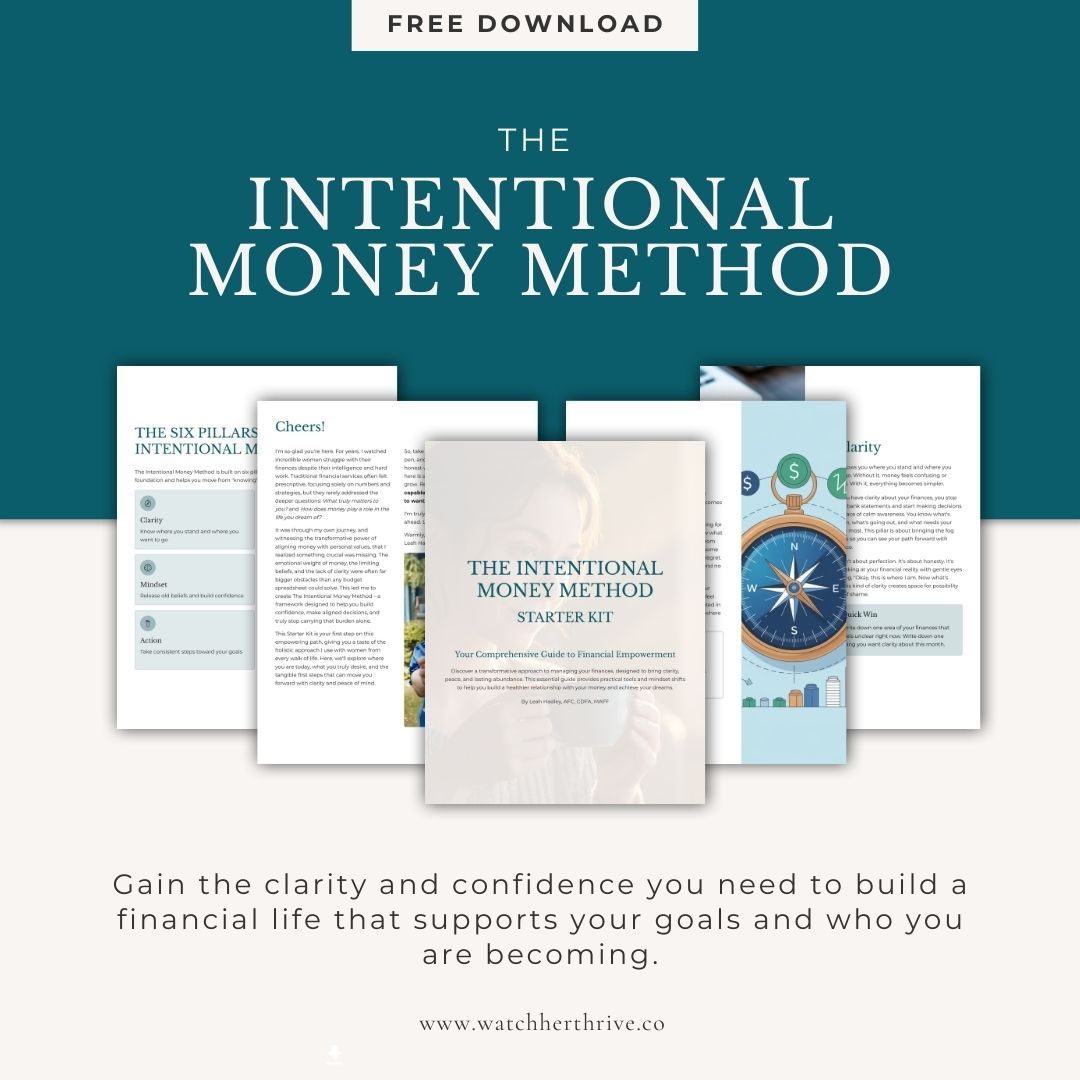
The first pillar of my Intentional Money Method is Clarity, and it applies beautifully here. Before any conversation about budgets or credit cards can go well, you and your young adult need to be crystal clear about the bas...
Building Financial Confidence: How Women Can Develop a Stronger Money Mindset and Take Intentional Action

I remember the full range of emotions I felt when I bought my first house in 2007. Pride that I was doing something so significant. Worry that I was making the wrong decision. Excitement to finally have a place of my own. And overwhelming anxiety about all the new expenses and responsibilities ahead of me.
What I didn't realize at the time was that I was doing exactly what it takes to build financial confidence. I was taking intentional action, even in the face of fear.
Building financial confidence is a journey, not a destination. With each financial decision, we get an opportunity to flex our confidence muscles. Yet so many women shy away from these moments due to fear, self-doubt, or the belief that they don't know enough yet. What if the very act of making decisions, imperfect, uncertain, sometimes scary decisions, is exactly what builds the confidence we're waiting to feel?

Clarity and Values Come First
Before you can take confident financial action, you need two things: cla...
10 Personal Finance Books for Grads

Personal finance books come in two varieties: entertaining or drier than twice-reheated pork chops. So, you may not think of giving recent graduates personal finance books for fear of wasting your money on a book they’ll never read (see: pork chops).
That said, there are some fantastic personal finance books out there! I love giving at least one of these ten books as graduation gifts because they all teach wise financial lessons in relatable ways so grads start out their young lives on the right financial foot.
(Our original post included five books, but I found five more that are worth checking out!)

1. The Latte Factor by David Bach
I love giving The Latte Factor as a gift to everyone, not just recent grads. This book is short and sweet, but very impactful. It teaches that no matter where you are in your personal finance journey, you have the power to achieve your financial goals. You’re richer than you think (and you didn’t have to take any big leaps to make that your reality)...
21 Wise Money Quotes for Financial Literacy Month

April is Financial Literacy Month! It’s such an important time for me because I truly believe in the importance of education, especially around money. The reality is that the schools don’t provide much, if any, financial education.
So, I want to make sure you have the tools to feel confident in sharing this information with your kids and also so you are confident in advocating for yourself when it comes to your finances.
I remember learning about money at a young age — I must have been about 10 and my brother was 15. My mom was a single mom. She hurt her back and couldn't go grocery shopping, so it fell to us (my brother and I) to go to the store and get what we needed.
It was the first time we had to be responsible to get the groceries and it was a little scary. We were in charge of making sure we chose wisely so we would all have food to eat for the whole week and hadn’t loaded the cart with groceries that would exceed our budget.
Even though it was a little nerve-wracking, that expe...
How to Teach Kids to Save Money (And Why It Matters More Than Ever)

One of the questions I hear most often from parents is some version of: "How do I get my kid to stop spending every dollar the second it lands in their hands?"
It is such a good question, and honestly, it is one I wrestle with in my own home too.
Here is what I know for certain: teaching kids to save money is not just about the dollars. It is about building the relationship with money that they will carry into adulthood. Every habit we help them form now, whether it is resisting the impulse buy or working toward a goal, is laying the foundation for the financial decisions they will face later.
And that is worth every conversation, every teachable moment, and yes, every negotiation over the toy aisle.
Why Teaching Kids to Save Is Harder Today
Let us be real: we are raising kids in the age of instant gratification. Two-day shipping. One-click purchasing. Digital wallets that make money feel invisible. The concept of waiting and saving runs completely counter to the world they are na...
The Best Board Games That Teach Kids About Money

No kid wants to sit down for a lecture about budgeting. And honestly, no parent really wants to give one.
But games? Games are different. When kids are playing, their guard is down. They are making decisions, dealing with consequences, navigating wins and losses, and absorbing concepts without realizing it is happening. That is exactly why I love using board games as a financial literacy tool.
I have been a financial planner for nearly two decades, and one thing I believe deeply is that the money habits and beliefs our kids develop start early. The conversations that happen around a game board, about why they ran out of money, about whether to spend or save, about what it means to owe someone else, are some of the most natural and effective financial education you can give.
These are the games we actually play in our house, along with what each one teaches.

Board Games for Teaching Kids About Money
The classic for a reason. Monopoly covers an impressive range of financ...

Leah Hadley, AFC, CDFA, MAFF
Leah Hadley, AFC® CDFA® MAFF™, is a bestselling author and financial planner with over 20 years of experience helping women build wealth with intention. She is the founder of Watch Her Thrive and Intentional Wealth Partners, and the author of Intentional Money: The Modern Woman's Guide to Building Wealth, Purpose & Peace.

Amazon Affiliate Disclosure
Watch Her Thrive is a participant in the Amazon Services LLC Associates Program, an affiliate advertising program designed to provide a means for sites to earn advertising fees by advertising and linking to amazon.com.
Investment Advisory Disclosure:
Leah Hadley is a Licensed Investment Adviser Representative and the Founder of Intentional Wealth Partners, a Registered Investment Adviser. Advisory services are offered exclusively through Intentional Wealth Partners.
Watch Her Thrive is not a Registered Investment Adviser and does not provide individualized investment advice, financial planning, or securities recommendations. All content provided through Watch Her Thrive is for educational and informational purposes only.