
How to Align Your Money With Your Values (Your Time and Energy Too)

Let me ask you something. If a stranger looked at your bank statement and your calendar from last month, what would they say you care about?
For a lot of women, the answer stings a little. Nothing is wrong, exactly. What they value and where their money, time, and energy actually go have just drifted apart without anyone deciding it.
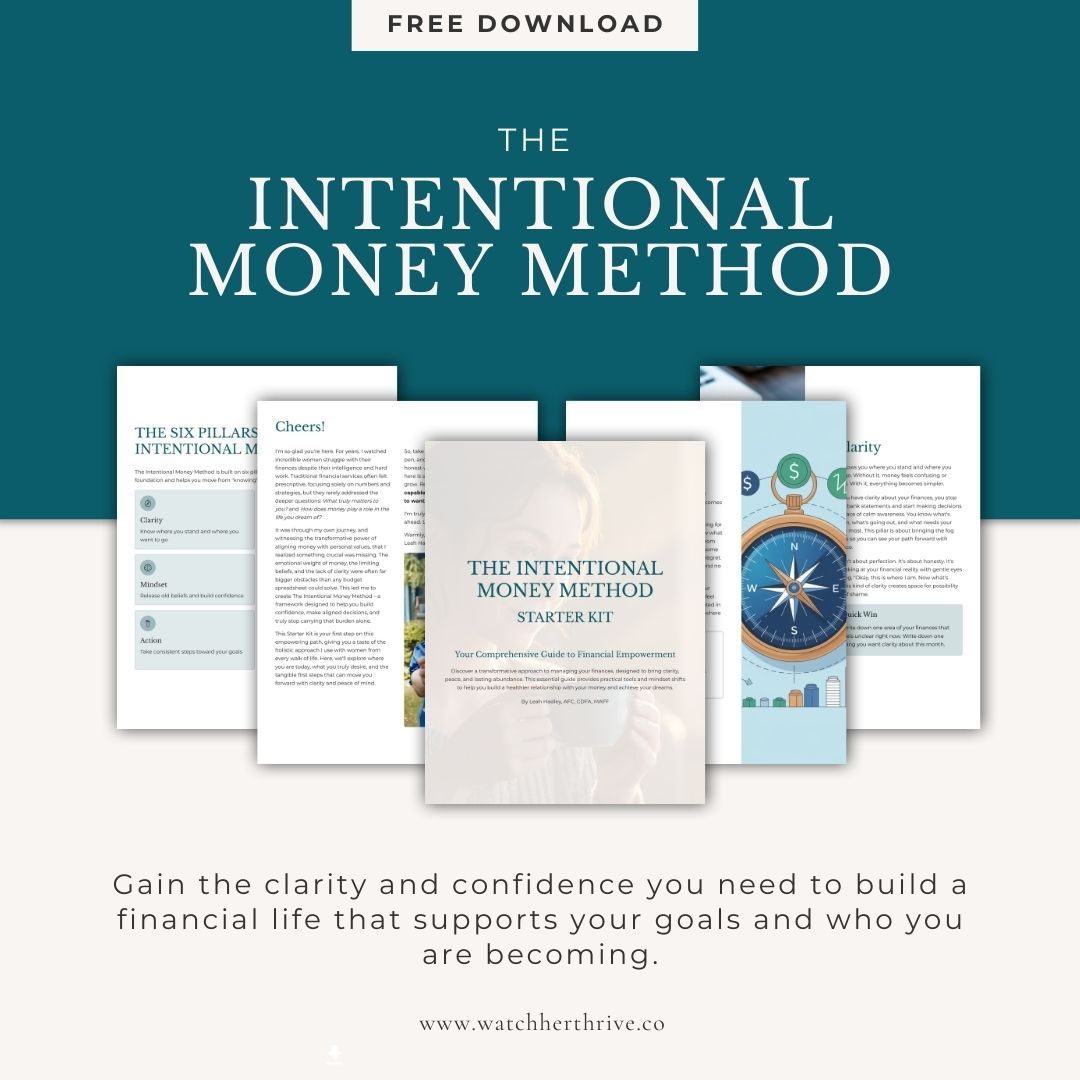
Aligning your money with your values means making sure your spending, saving, giving, and investing reflect what matters most to you, not what you think should matter or what everyone around you is doing. It's the Values pillar of the Intentional Money Method, and it's where every other money decision gets its direction.
Why your money and your values drift apart
Nobody sets out to spend money on things they don't care about. Drift happens because most financial decisions aren't really decisions. They're defaults. The subscription that renewed. The house that fit the life you had five years ago. The dinner out that started as a treat and quietly became the plan for every Thursday.
Defaults come from somewhere, too. A lot of what we spend on reflects beliefs we absorbed long before we earned a paycheck. I wrote about that in where your money beliefs come from. If money feels emotional, that's not a problem to solve. It's information.
Money drifts away from your values when nobody stops to ask what it's for.
The question that changed how I think about money
My own turning point came from something small. A friend posted about her new SUV, and I realized I was chasing someone else's definition of success.
So I changed the question. I stopped asking "How do I get more?" and started asking "What would enough actually look like for me?"
That question is the heart of aligning your money with your values. Enough isn't a number someone else can hand you. It's a line you draw based on what matters to you. Once it's drawn, a lot of spending stops being tempting and a lot of saving stops feeling like sacrifice.

Your values are filters, not words on a wall
Most values exercises have you circle words like family, freedom, or security and call it done. Naming the words isn't the hard part. Using them is.
In the Intentional Money Method, values are living filters. They guide what you say yes to and what you let go of. You'll know yours are working when decisions get quicker and you stop second-guessing them afterward. If a purchase leaves you feeling guilty, or you keep revisiting a choice you already made, it usually didn't pass through your values first.
Try naming three values. Then write one sentence for each describing what it looks like in your actual week. "Family" becomes "Sunday dinner with my kids, and money set aside so I can say yes to their big moments." Now it's something you can hold your spending up against.
Align your time and energy, too
Most advice about values-based money stops at the budget. But money is only one of the resources you invest every day. Your time and your energy get spent too, and they drift just as easily.
I want women to own the decision of how their time, energy, and resources are invested. If you value your health and your calendar has no room for it, that's the same misalignment as a budget with no line for something you say matters. The fix is the same, too. Decide on purpose, then build it in.
Sometimes the best money move you can make is protecting your energy. Saying no to a commitment that drains you leaves room to earn, plan, and give in ways that reflect who you are.
Where your values show up in your money
The Intentional Money Method has six practical steps, and three of them are where your values become most visible.
Spend with purpose. Purposeful spending isn't about spending less. It's about spending in a way you'd happily explain if someone asked why. A spending plan is the tool that makes this visible month to month.
Save and invest for what you're building. Saving feels like deprivation when the goal is vague. When it's tied to a value you named, like flexibility, security for your family, or a business you want to start someday, the same contribution starts to feel like a choice you're making for yourself.
Give with heart. Generosity is one of the clearest expressions of what you value, and it's how your money reaches beyond your own life. That might mean a cause you care about, your community, or the people you love. If giving across generations is on your mind, I wrote about starting legacy planning conversations with your family.
Your practical takeaway
This week, set aside 20 minutes for a values check. Pull up last month's bank statement and your calendar side by side. Mark what clearly reflects one of your three values. Then find the one expense and the one commitment that clearly don't.
You don't have to fix everything. Pick one misalignment and make one change. Cancel it, move the money, or say no. Then put a recurring monthly date on your calendar to repeat the check, so alignment becomes a system instead of a good intention. My post on goals vs. intentions gets into why that difference matters.
Questions women ask about aligning money with values
What does it mean to align your money with your values? It means your spending, saving, giving, and investing reflect what matters most to you. When they're aligned, spending feels purposeful and saving doesn't feel like sacrifice. When they're not, you'll often notice guilt, second-guessing, or a sense that your money isn't really yours.
How do I figure out what my values actually are? Look at what you'd protect if money got tight, and what you'd do more of if it didn't. Then test each value by describing what it looks like in a real week. If you can't describe it, it may be a value you think you should have rather than one you actually hold.
What if my partner and I value different things? That's common, and it's workable. Start by naming each person's top values separately, then look for where they overlap and where each of you needs some money that's yours to decide. My post on money and relationships goes deeper on getting on the same page.
How often should I check whether my spending matches my values? Once a month is enough for most people. Your values tend to stay steady, but your life changes, and your money should change with it.
Is values-based spending the same as budgeting? Not quite. A budget tells you how much goes where. Your values tell you why. You need both, and the Intentional Money Method puts the why first.
Alignment is easier with company
Owning the decision doesn't mean making it by yourself. The Empowered Sisterhood is for women who want to make a bigger impact and know that means taking their wealth seriously. It's a room where you can say out loud what you're changing and have someone ask you next week how it went. If you're ready to make your money look like what you care about, come join us.
P.S. If you want the whole framework in one place, my book Intentional Money: The Modern Woman's Guide to Building Wealth, Purpose, and Peace walks through all six pillars and six steps.
Free: Intentional Investing for Women
My 24 page guide to aligning your portfolio with your goals. If investing has always felt like a language other people speak, start here.

Leah Hadley, AFC, CDFA, MAFF
Leah Hadley, AFC® CDFA® MAFF™, is a bestselling author and financial planner with over 20 years of experience helping women build wealth with intention. She is the founder of Watch Her Thrive and Intentional Wealth Partners, and the author of Intentional Money: The Modern Woman's Guide to Building Wealth, Purpose & Peace.

Amazon Affiliate Disclosure
Watch Her Thrive is a participant in the Amazon Services LLC Associates Program, an affiliate advertising program designed to provide a means for sites to earn advertising fees by advertising and linking to amazon.com.
Investment Advisory Disclosure:
Leah Hadley is a Licensed Investment Adviser Representative and the Founder of Intentional Wealth Partners, a Registered Investment Adviser. Advisory services are offered exclusively through Intentional Wealth Partners.
Watch Her Thrive is not a Registered Investment Adviser and does not provide individualized investment advice, financial planning, or securities recommendations. All content provided through Watch Her Thrive is for educational and informational purposes only.