
Where Your Money Beliefs Come From (And How to Change Them)

The first thing I learned about money had nothing to do with a bank account.
I was about ten years old. My mom was a single mom, and she had hurt her back badly enough that she could not go grocery shopping. So she sent my brother and me to the store with a list and a set amount of cash. I remember standing in the aisle doing math in my head, trying to figure out if we had enough for everything on the list. We did not. We had to make choices about what to put back.
That experience taught me something I carry to this day: money is about choices. It is about trade-offs. And your feelings about those trade-offs start forming long before you ever earn a paycheck.
I share this because when I sit down with a new client and we start talking about money, the conversation almost always goes deeper than numbers. It goes to a place that feels more like identity. She will say something like, "I have always been bad with money." Or, "I do not deserve to have more than I need." Or, "Money just stresses me out, so I avoid thinking about it."
These are not facts. They are beliefs. And the beliefs you carry about money quietly shape every financial decision you make, from whether you negotiate your salary to whether you open your investment statements to whether you feel worthy of building real wealth.

What Is a Money Belief?
A money belief is any assumption you hold about what money means, what you deserve, and what is possible for you financially. Some money beliefs are helpful. "I am capable of learning how to manage my money" is a belief that opens doors. But many of the beliefs we carry are limiting, and they often feel so deeply true that we mistake them for reality.
Here are some of the most common limiting money beliefs I hear from clients:
"I am not good with money." "People like me do not build wealth." "Wanting more money makes me greedy." "I will never be able to retire comfortably." "I do not make enough to invest." "Rich people are selfish." "If I focus on money, I am being materialistic." "My family has always struggled with money, so that is just how it is."
Any of those sound familiar? If so, you are not alone. And more importantly, none of those statements are permanently true. They are stories, and stories can be rewritten.

Where Money Beliefs Come From
Your money beliefs did not appear out of nowhere. They were formed by real experiences, usually early ones, and they have been reinforced over years of repetition. Here are the most common sources.
Your family of origin. This is the biggest one. The way your parents or caregivers talked about money (or refused to talk about it) shaped your earliest understanding of what money means. If money was a source of constant stress in your household, you may have internalized the belief that money is inherently stressful. If money was never discussed at all, you may have learned that money is something shameful or private, not to be talked about openly. If one parent controlled all the finances and the other had no visibility, you may have absorbed the idea that money is about power, not partnership.
Your cultural and social environment. The community you grew up in, your religious upbringing, your socioeconomic background, the messages you absorbed from media and advertising all play a role. Women in particular receive a lifetime of cultural messaging that we are bad with money, that financial ambition is unfeminine, that someone else (a spouse, an advisor, a parent) should handle the big financial decisions. These messages are pervasive and they do real damage.
Your personal financial experiences. A job loss, a divorce, a period of debt, an investment that went wrong, a time when you could not make rent. These experiences create emotional imprints that stay with you. One bad experience with investing can create a belief that investing is "too risky" that persists for decades, even when the math says otherwise.
The financial industry itself. Let us be honest: the financial world has not historically been welcoming to women. Jargon-heavy language, condescending advisors, products designed for a demographic that does not look like most of us. If you have ever walked out of a meeting with a financial professional feeling confused or talked down to, that experience shaped your relationship with money too.

How to Identify Your Money Beliefs
Before you can change a belief, you have to see it clearly. Here are three ways to surface your money beliefs.
Pay attention to your self-talk. For one week, notice what you say to yourself (and to others) about money. Write it down. Do not filter or judge it. Just capture the words. You will start to see patterns. "I cannot afford that" might show up constantly, even when you can technically afford it. "Must be nice" might come out every time you see someone with something you want. These phrases are clues.
Trace it back. When you catch a money belief, ask yourself: where did I first learn this? Can I remember a specific moment? Usually you can. It might be a parent saying, "Money does not grow on trees." It might be watching your family lose a home. It might be a partner telling you that you spend too much. The belief is not the event itself. The belief is the conclusion you drew from the event.
Notice where you avoid. The places where you avoid dealing with money are often the places where limiting beliefs live. If you never check your bank balance, ask yourself what you are afraid of seeing. If you refuse to talk about money with your partner, ask yourself what you believe will happen if you do. If you have been meaning to start investing for years but have not done it, ask yourself what story you are telling yourself about why. Avoidance is a belief in disguise.
How to Change a Limiting Money Belief
Identifying a belief is the first step. Changing it takes intentional, consistent effort. This is one of the six pillars of the Intentional Money Method, what I call "shifting your mindset," and it is the pillar where I see the most dramatic transformation in clients.
Here is the process I walk people through.
Name the belief specifically. Not "I have money issues." Get precise. "I believe that I will never be able to save money because I have never been able to before." Specificity takes the power out of it. A vague belief feels like truth. A specific belief feels like a sentence you can examine.
Question it honestly. Is this belief actually true? Has it always been true? Can you think of a single exception? Usually you can. If you believe you cannot save money, but you once saved up for a vacation or put together a security deposit, the belief is already disproven. You can save. You have. The belief is not a fact. It is a habit of thinking.
Replace it with something grounded, not just positive. I am not going to tell you to stand in front of a mirror and say "I am a money magnet." That kind of affirmation does not work for most people because it does not feel true, and your brain rejects statements it does not believe. Instead, replace the old belief with something honest and evidence-based. "I have not been consistent with saving in the past, and I am building new habits now" is a statement your brain can accept. It acknowledges reality and points toward growth at the same time.
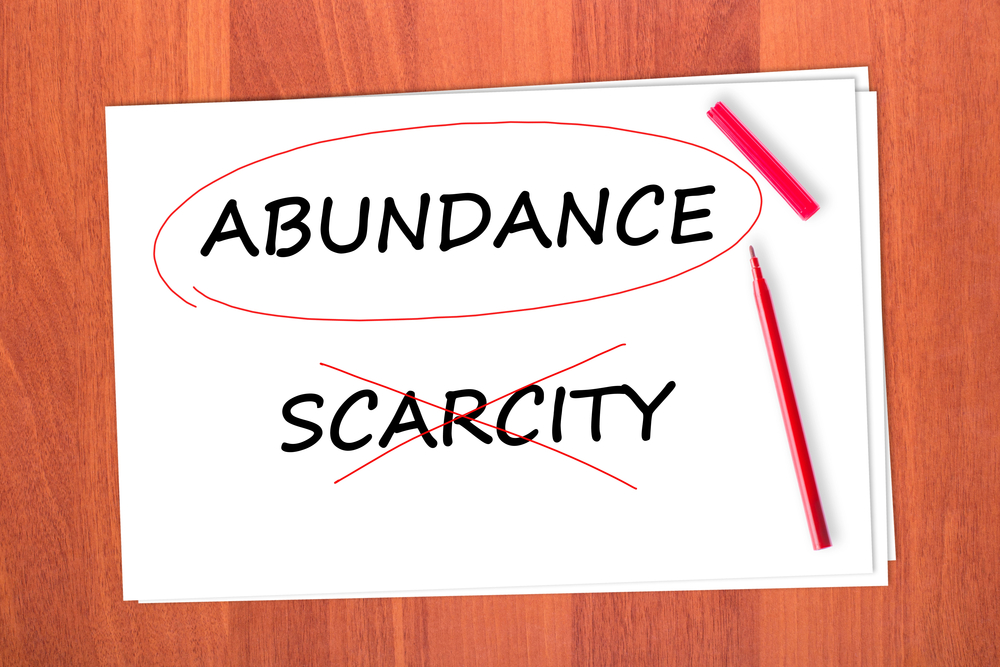
I wrote about this in more depth in my post on scarcity vs. abundance mindset, where I talk about the difference between making decisions from fear versus making them from clarity. The same principle applies here. The goal is not to force yourself into blind optimism. The goal is to get clear enough to make decisions that actually serve your future.
Take one small action that contradicts the old belief. Beliefs change faster when they are paired with behavior. If you believe you are bad with money, set up one automatic transfer to savings, even $25. If you believe investing is not for people like you, open a brokerage account and fund it with $50. You do not have to go big. You just have to do something that proves the old story wrong. Action builds evidence, and evidence builds new beliefs.
Get support. Changing money beliefs in isolation is hard because the people around you may reinforce the old ones. This is one of the reasons I created The Empowered Sisterhood, a community where women can talk about money honestly, without judgment, and with the support of other women doing the same work. When you hear another woman say "I used to believe that too, and here is what changed for me," it rewires something that no amount of solo journaling can reach.
Why This Matters More Than Any Financial Strategy
I can build you the most sophisticated financial plan in the world, and if you believe you do not deserve wealth or that you are not capable of managing money, you will sabotage that plan. I have watched it happen. A client will have a clear investment strategy, a solid budget, and a growing net worth, and she will still feel anxious, avoidant, or like a fraud.
That is not a planning problem. That is a belief problem.
This is why the Intentional Money Method does not start with strategy. It starts with clarity and values and mindset. Because until you understand what you believe about money and why, the strategies will not stick.
The good news is that money beliefs are not permanent. They are learned, which means they can be unlearned. The woman who grew up believing she was "bad with money" can become the woman who manages her finances with confidence. I have seen it happen hundreds of times. It starts with awareness, and it grows with intention.

If you are beginning to see your own money beliefs more clearly and want to keep going, I wrote Intentional Money to walk you through this exact process in depth. And if you want to do this work alongside other women, The Empowered Sisterhood is where that happens every month.
Your money story started a long time ago. But you get to decide how the next chapter goes.
Free: Intentional Investing for Women
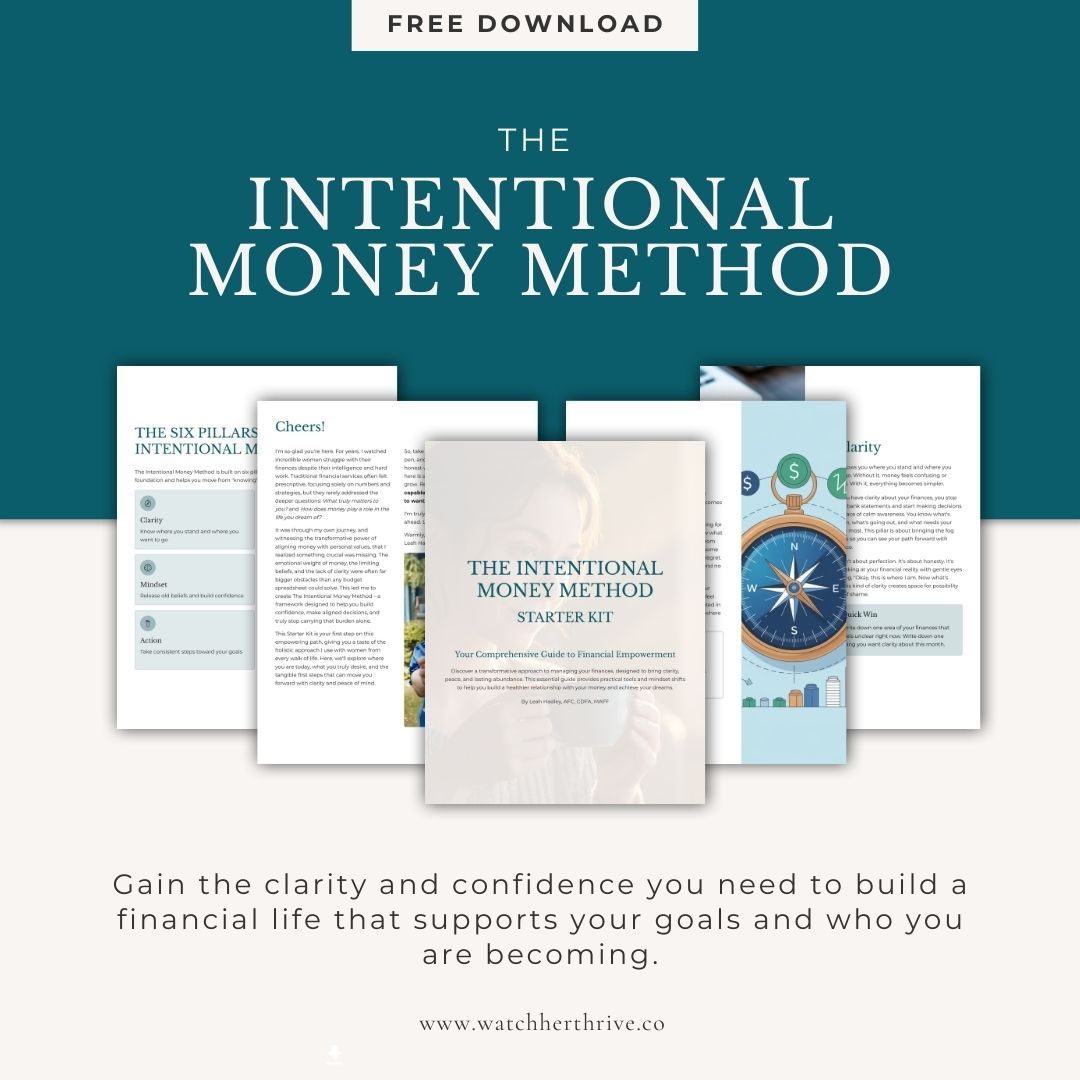
My 24 page guide to aligning your portfolio with your goals. If investing has always felt like a language other people speak, start here.

Leah Hadley, AFC, CDFA, MAFF
Leah Hadley, AFC® CDFA® MAFF™, is a bestselling author and financial planner with over 20 years of experience helping women build wealth with intention. She is the founder of Watch Her Thrive and Intentional Wealth Partners, and the author of Intentional Money: The Modern Woman's Guide to Building Wealth, Purpose & Peace.

Amazon Affiliate Disclosure
Watch Her Thrive is a participant in the Amazon Services LLC Associates Program, an affiliate advertising program designed to provide a means for sites to earn advertising fees by advertising and linking to amazon.com.
Investment Advisory Disclosure:
Leah Hadley is a Licensed Investment Adviser Representative and the Founder of Intentional Wealth Partners, a Registered Investment Adviser. Advisory services are offered exclusively through Intentional Wealth Partners.
Watch Her Thrive is not a Registered Investment Adviser and does not provide individualized investment advice, financial planning, or securities recommendations. All content provided through Watch Her Thrive is for educational and informational purposes only.