
How to Build Healthy Financial Habits (The Hard Truth Nobody Talks About)

In August 2024, I had VSG surgery. Vertical sleeve gastrectomy. A major procedure that permanently changed the size of my stomach, and with it, my entire relationship with food.
The recovery was hard. Not primarily because of the physical pain, although it was certainly uncomfortable. It was hard because for the first time in my life, I could not use food for comfort. Not even a little. While my stomach healed, food as a coping mechanism was completely off the table. And that meant I had to sit with every uncomfortable emotion I had been numbing for years.
That experience cracked something open in me. Because I had spent years sitting across from clients who were doing the exact same thing with their money.
Not facing their numbers. Not opening the statements. Spending in ways that felt good in the moment and terrible afterward. Using money the way I had been using food. As a way to avoid feeling something they did not want to feel.
When you cannot run from the hard thing anymore, you learn something essential about building healthy habits. The turning point is never the strategy. It is the moment you finally face the truth.

I Have Been Through My Own Version of This
I want to be clear about something. I did not need the VSG surgery to teach me about money. I spent my 20s and 30s doing the hard inner work to transform my relationship with finances. I sat with the discomfort. I examined the stories I had inherited about money. I built habits and then rebuilt them after life threw curveballs. That work did not happen overnight, and it was not pretty.
But my health journey in my 40s reminded me of exactly what my clients go through when they first start working on their finances. That feeling of being stripped of your usual escape routes. That moment when you have to look directly at the thing you have been avoiding and decide what you are going to do about it.
I share this publicly and specifically because I believe that is what real leadership looks like. Not performing wellness or financial confidence from a highlight reel. Showing the actual work. The actual struggle. The actual turning point.
And because if you have ever avoided opening a financial statement, or felt a wave of shame after an impulse purchase, or told yourself you will deal with your money stuff later, I want you to know: I have been there. So have most of the women I work with. You are not broken. You are human. And there is a way through.
Related reading: The Hidden Cost of Financial Avoidance: Why Women Avoid Their Money and How to Stop
Why Financial Habits Are So Hard to Build
We do not have a shortage of financial information. Podcasts, books, apps, Instagram infographics. Women today have access to more money guidance than any generation before them. And yet financial anxiety among women is at an all-time high. Most women still feel underprepared for retirement. Most still feel vaguely guilty about their spending. Most still feel like they should be doing better.
The problem is not information. The problem is that most financial advice skips straight to tactics without addressing the emotional and psychological foundation that those tactics have to be built on. You can download the best budgeting app in the world, but if you are using spending to cope with stress, loneliness, or anxiety, that app is not going to fix anything. You need to face the hard thing first.
This is exactly why I built the Intentional Money Method the way I did. Because lasting financial habits require more than a spreadsheet. They require you to look at the whole picture.

The Intentional Money Method: Building Habits That Actually Stick
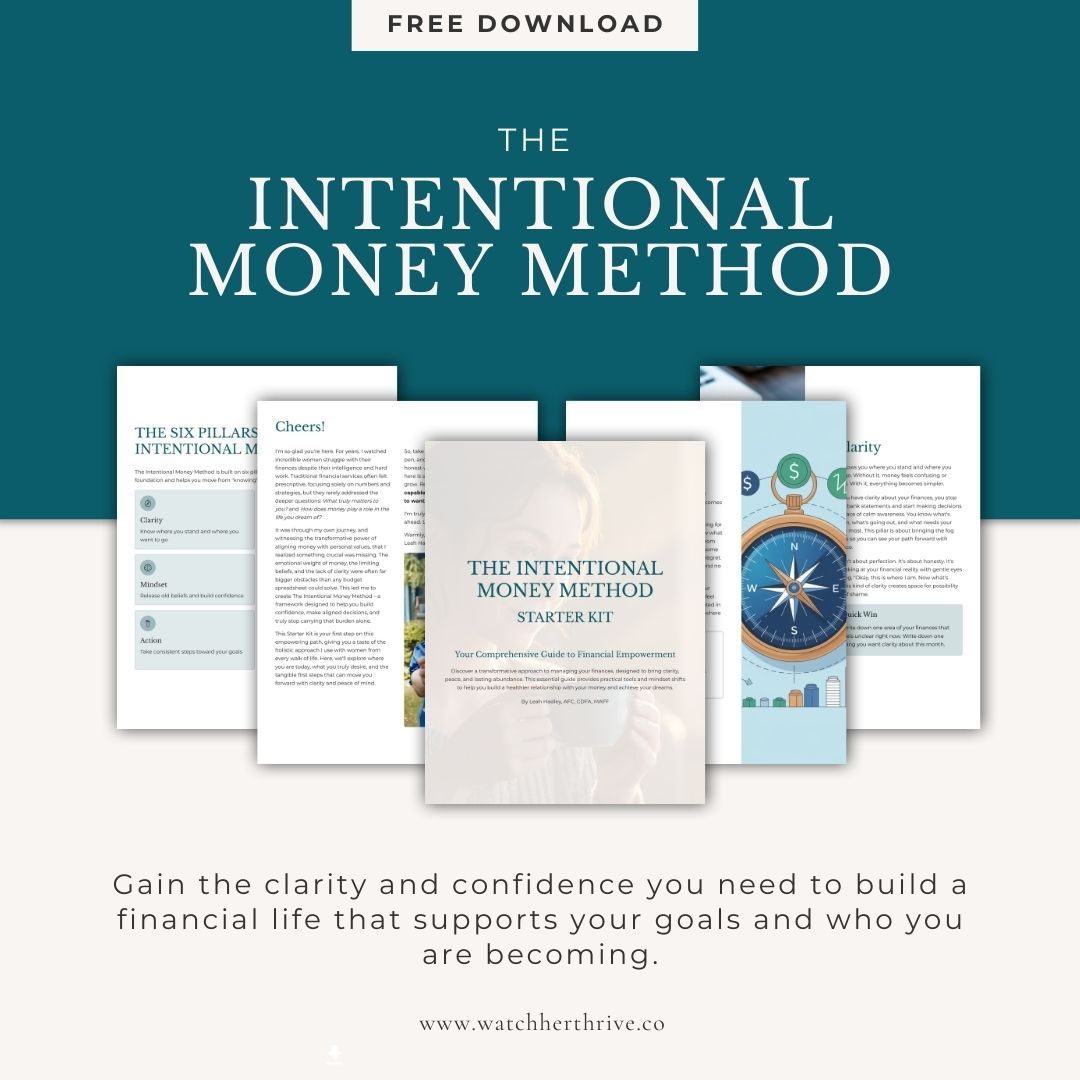
The Intentional Money Method is a six-pillar framework I developed over more than a decade as a financial advisor, working with women through major financial transitions, and from my own experience doing this work. Each pillar matters. You cannot skip to the end.
1. Clarity: Face the Numbers
You cannot build healthy habits around something you are actively avoiding. The first step is getting clear on where you actually stand. Pull up your accounts. Know your numbers. Understand exactly where your money is going.
This step feels like the scariest one. But here is the truth: the anxiety lives in the avoidance, not in the numbers themselves. When you finally look, you take your power back. Clarity is not the enemy. Avoidance is.
2. Values: Connect Your Money to What Actually Matters
Most people build a budget around numbers. I build financial plans around values. Because when your spending and saving reflect what you actually care about, making good financial decisions stops feeling like deprivation. It starts feeling like integrity.
Ask yourself: what do I actually want my life to look like? Not what you think you should want. What matters most to you? That answer is the foundation every healthy financial habit needs to be built on.
3. Mindset: Deal with the Stories Underneath
This is the pillar most financial professionals skip entirely. And it is the one that undoes the most carefully constructed plans.
Your money mindset is the collection of beliefs, stories, and emotions you have been accumulating about money since childhood. Maybe you grew up in a household where money meant conflict. Maybe you were taught that wanting financial security was selfish. Maybe a divorce or a setback left you feeling like you simply cannot be trusted with money.
Those stories live in your nervous system. And just like food addiction does not disappear because you know intellectually that vegetables are healthier than chips, money avoidance does not disappear because you know you should be saving more. You have to go under the behavior and address what is driving it. That is where the real change happens.

4. Strategy: Build a Plan for Your Real Life
Now we can talk tactics. A financial strategy built on clarity, values, and a healthier mindset is a completely different animal from one built on fear, comparison, or shame. It is personalized. It is sustainable. It is designed to work with who you actually are, not who you think you should be.
Healthy financial habits at the strategy level look like automating savings so willpower is not required. They look like a weekly five-minute money check-in instead of a monthly panic. They look like knowing your net worth and tracking it over time. Small, repeatable actions that compound into something significant.
5. Action: Start Before You Feel Ready
Here is something nobody tells you about building healthy habits: you will never feel fully ready. There will always be a reason to wait. A better time. A cleaner slate. More information. More money. More confidence.
After my VSG surgery, I did not wait until I felt like I had it all together before I started working with Mo and Kelly. I started while I was still figuring it out. That is the only way habits get built. You begin, imperfectly, and you keep going.
Increase your 401(k) contribution by one percent. Open the savings account. Have the money conversation you have been putting off. Action is the bridge between intention and transformation. You just have to step onto it.
6. Support: The Ingredient That Changes Everything
My health journey made this crystal clear to me in a way I will never forget. When I was in recovery from surgery, stripped of my usual comfort mechanism, I needed support. Not just medical support. Human support. People who could hold space for how hard it was and walk alongside me anyway.
Working with Mo and Kelly was not just about learning how to exercise. It was about having people who showed up for me, who knew my history, and who kept believing I was capable even when I was not sure. That kind of support is what turns an intention into a habit.
The same is true for your finances. Willpower runs out. Life gets complicated. The voice that says you will deal with it later is loud. But when you have a community of women around you who are doing the work too, when you have accountability and coaching and a space where you are not alone in this, everything shifts.
Support is not a bonus. It is a prerequisite for lasting change.

Five Strategies for Building Financial Habits That Actually Stick
Here is something I want you to understand before we get into tactics: you do not need more willpower to build better financial habits. You need a better system. These five strategies are research-backed, and I have watched them work with hundreds of women. Pick one. Start there.
1. Start Stupidly Small
The biggest mistake people make when building new habits is trying to change too much at once. Your brain resists big changes because they feel risky and unfamiliar. But your brain accepts tiny changes. Tiny changes feel safe.
So instead of “I am going to track every single expense,” try “I am going to check my bank balance every morning.” Instead of “I am going to save $500 a month,” try “I am going to transfer $10 to savings every Friday.” Start so small it almost feels ridiculous. That is how you know you are on the right track. Once that tiny habit becomes automatic, you build on it.
2. Stack New Habits onto Existing Ones
This is one of the most powerful techniques in behavioral science, and it is exactly what James Clear talks about in Atomic Habits. The idea: use an existing habit as the trigger for a new one. The formula is simple. “After I [existing habit], I will [new habit].”
For example:
- “After I pour my morning coffee, I will check my account balances.”
- “After I get paid, I will transfer money to savings before I do anything else.”
- “After I finish dinner on Sunday, I will spend 10 minutes reviewing my spending for the week.”
You are not creating a new reminder system from scratch. You are piggybacking on something your brain already does automatically. That is why it works.
3. Make Good Habits Easier Than Bad Ones
The easier something is, the more likely you are to do it. So your job is to reduce the friction around the habits you want to build, and increase the friction around the ones you want to break.
Set up an automatic savings transfer so the decision is made once and then never again. Put your bills on autopay. On the flip side, if impulse online shopping is a problem, delete the apps from your phone. Unsubscribe from promotional emails. Make the bad habit require more effort than it is worth. You are not relying on willpower. You are designing your environment to work for you.
4. Track Your Progress Visually
What gets measured gets managed. When you track your habits visually, something shifts. Get a calendar. Every day you complete your money habit, put a checkmark on it. That is it. Just a checkmark.
After a few days, you have a streak. And you do not want to break the streak. The streak itself becomes the motivation. You can also track a running total of how much you have saved or how much debt you have paid off. Make your progress visible. When you can see it, you are far more likely to keep going.
5. Plan for When You Mess Up (Because You Will)
Missing one day does not ruin everything. Missing two days in a row is where habits start to break down. So have a plan before you need it. “If I miss my Sunday spending review, I will do it Monday morning.” “If I forget to transfer to savings on payday, I will do it the next day.”
And be kind to yourself when you slip. I mean this. Shame does not build habits. It breaks them. Beating yourself up does not make you more likely to follow through. It makes you more likely to quit. You are human. You will mess up. That is part of the process, not evidence that you have failed.

Frequently Asked Questions
How long does it take to build a financial habit?
There is no fixed number, despite what you may have heard about 21 days. Research suggests it varies widely depending on the person and the complexity of the behavior, and simple habits automate faster than complicated ones. That is one more reason to start with something small enough that it barely requires a decision.
Why do my financial habits keep failing?
Usually because the habit was designed to require willpower, and willpower runs out. If a habit only works on the weeks when you are rested and organized, it is not a habit, it is an intention. Automate what you can, shrink what you cannot, and build in a plan for the days you slip.
What is the easiest financial habit to start with?
Checking your account balance once a day, at the same time, attached to something you already do. It takes under a minute, it requires no decisions, and it quietly ends the avoidance that makes everything else harder. Most women find that this one habit changes how they feel about their money before it changes any number in it.
How do I stay consistent with money habits when life gets busy?
Design for your worst week, not your best one. A habit that survives a hard week is worth more than an ambitious one that only works when everything is calm. Automate the things that must happen, and let the optional ones flex.
Can I build good financial habits if I have never been good with money?
Yes, and the belief that you are simply not good with money is usually part of what is in the way. That belief was learned, which means it can be examined and set down. Start with one small habit and let the evidence accumulate.
You Do Not Have to Figure This Out Alone
I spent my 20s and 30s doing the hard work of building a healthy relationship with money. It was not linear. It was not always pretty. But I did it, and it changed my life. In my 40s, I started a completely different kind of hard work with my health. And through both of those journeys, the common thread that made all the difference was this: I did not go it alone.
That is exactly why I created The Empowered Sisterhood. Because the women who come to me are not lacking information. They are lacking a community that takes their financial lives seriously. A space that honors the emotional complexity of money alongside the practical strategy. A place where they can face the hard truths and do the work with real support.
Inside The Empowered Sisterhood, you get monthly masterclasses built around the Intentional Money Method, direct access to me and my team, and a community of women who are done avoiding the hard things and ready to build something real.
If you are tired of going it alone, come join us. The turning point you have been waiting for might just be the community you have been missing.
Free: Intentional Investing for Women
My 24 page guide to aligning your portfolio with your goals. If investing has always felt like a language other people speak, start here.

Leah Hadley, AFC, CDFA, MAFF
Leah Hadley, AFC® CDFA® MAFF™, is a bestselling author and financial planner with over 20 years of experience helping women build wealth with intention. She is the founder of Watch Her Thrive and Intentional Wealth Partners, and the author of Intentional Money: The Modern Woman's Guide to Building Wealth, Purpose & Peace.

Amazon Affiliate Disclosure
Watch Her Thrive is a participant in the Amazon Services LLC Associates Program, an affiliate advertising program designed to provide a means for sites to earn advertising fees by advertising and linking to amazon.com.
Investment Advisory Disclosure:
Leah Hadley is a Licensed Investment Adviser Representative and the Founder of Intentional Wealth Partners, a Registered Investment Adviser. Advisory services are offered exclusively through Intentional Wealth Partners.
Watch Her Thrive is not a Registered Investment Adviser and does not provide individualized investment advice, financial planning, or securities recommendations. All content provided through Watch Her Thrive is for educational and informational purposes only.